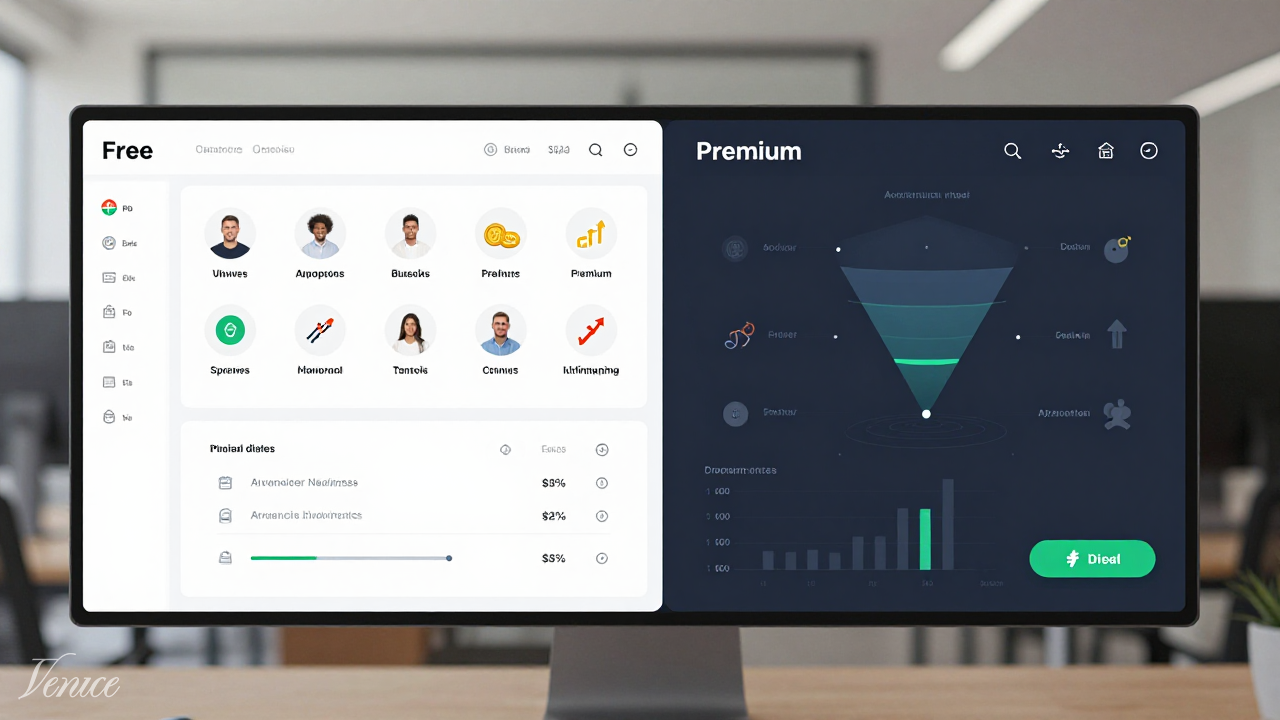
Open source software powers 96% of web servers and 90% of the world’s supercomputers, creating $8.8 trillion in economic value annually. The open source business model addresses key challenges like high development costs and slow innovation by leveraging global developer communities while generating sustainable revenue through strategic monetization.
Open Source Business Model Fundamentals
Core Problems Solved
The open source business model solves several critical issues:
- Cost Reduction: Enterprises save billions by avoiding proprietary software licensing fees.
- Innovation Acceleration: Community contributions deliver updates 10x faster than closed development.
- Vendor Lock-in: Users avoid dependency on single providers through interoperable standards.
How It’s Used
Organizations adopt open source strategies to:
- Build developer ecosystems around core products.
- Offer premium services around free software.
- Create competitive moats through network effects.
Detailed Monetization Strategies
Open Core Model
The most popular open source business model, used by 60% of commercial OSS companies, offers free core functionality while charging for enterprise features.
Examples:
- MongoDB: Community Edition (free) vs. Enterprise Advanced ($57/user/month).
- GitLab: Core features open source, premium CI/CD pipelines paid.
Revenue: $2.1B ARR for MongoDB in 2025.
Hosted SaaS Model
Companies host open source software as managed services, charging for convenience and reliability.
Examples:
- GitHub Actions: Free for public repos, enterprise plans at $21/user/month.
- Elastic Cloud: Managed Elasticsearch starting at $16/month.
Benefits: 85% customer retention through operational lock-in.
See also: Freemium Business Model
Dual Licensing Strategy
Same codebase licensed under OSS for community use and commercial licenses for proprietary needs.
Examples:
- MySQL: GPL for community, commercial license for Oracle customers.
- Qt: LGPL for open source, commercial for proprietary applications.
Professional Services & Support
Mission-critical software generates revenue through consulting and SLAs.
Examples:
- Red Hat Enterprise Linux: $5B ARR from support contracts.
- PostgreSQL support from EDB: $100M+ annual revenue.
Customer Types and Benefits
Enterprise Customers
Types: Fortune 500 companies, financial institutions, government agencies.
Benefits:
- Compliance certifications (SOC2, FedRAMP).
- 24/7 enterprise support.
- Custom integrations and SLAs.
Statistics: 95% of Fortune 500 use open source commercially.
Developer Communities
Types: Individual developers, startups, academic institutions.
Benefits:
- Free access accelerates learning and prototyping.
- Community forums and documentation.
- Early feature access via beta programs.
SMBs and Agencies
Types: Digital agencies, SaaS companies, consulting firms.
Benefits:
- Cost-effective scaling without licensing fees.
- Rapid deployment through Docker images.
- Ecosystem integrations (Kubernetes, Terraform).
Challenges and Mitigation Strategies
Dependency Risks
Challenge: Supply chain attacks affecting 70% of enterprises.
Solutions:
- SBOM (Software Bill of Materials) requirements.
- Multi-vendor sourcing strategies.
- Internal security scanning tools.
Sustainability Concerns
Challenge: 80% of OSS projects have fewer than 5 maintainers.
Solutions:
- Corporate sponsorship programs (e.g., GitHub Sponsors: $10M+ distributed).
- Foundation support (Linux Foundation, Apache).
- Government funding initiatives.
Quality Control
Challenge: Variable code quality across contributors.
Solutions:
- Automated testing pipelines (95% test coverage).
- Code review requirements.
- LTS (Long Term Support) branches.
Real-World Success Metrics
Economic Impact
- $8.8T annual value created globally (HBS study).
- Open source services market: $25B in 2022 → $84B by 2030 (Grand View Research).
- Linux Foundation members: 1,000+ enterprises investing $1B+ annually.
Performance Superiority
Commercial open source outperforms closed source by 2.7x in VC-backed startup exits (Linux Foundation 2025 report).
Conclusion
The open source business model transforms software development by combining community innovation with enterprise-grade monetization. Open core, hosted SaaS, dual licensing, and professional services create sustainable revenue while solving critical business challenges like cost, speed, and flexibility.
Innovative Thought: AI-driven code generation will accelerate open source dominance, enabling autonomous development ecosystems where AI agents contribute to repositories, creating self-improving software stacks that outpace traditional development by orders of magnitude.